
Deep Cleaning vs Regular Cleaning in Beirut | What You Need to Know
Regular cleaning keeps a home presentable. Deep cleaning keeps it genuinely clean. These are not the same thing, and understanding the difference matters — particularly in a city like Beirut where environmental conditions accelerate buildup in ways that surface cleaning cannot address.
The Fundamental Distinction
Regular cleaning is maintenance. It addresses the surfaces that are used daily — floors, counters, sinks, toilets — and keeps them from visibly deteriorating between cleans. Done consistently, it prevents the accumulation of grime on the surfaces you interact with directly.
Deep cleaning is remediation. It addresses everything that regular cleaning skips: the grout between tiles, the inside of kitchen cabinets, the space behind appliances, the top of door frames, the inside of window tracks, the seals around bathtubs and sinks. These areas accumulate contamination slowly and invisibly, and they cannot be reached with the tools and time available during a routine clean.
The distinction is not about effort or care. A household that cleans diligently every week will still accumulate deep contamination over time, because regular cleaning is not designed to reach the areas where that contamination settles.
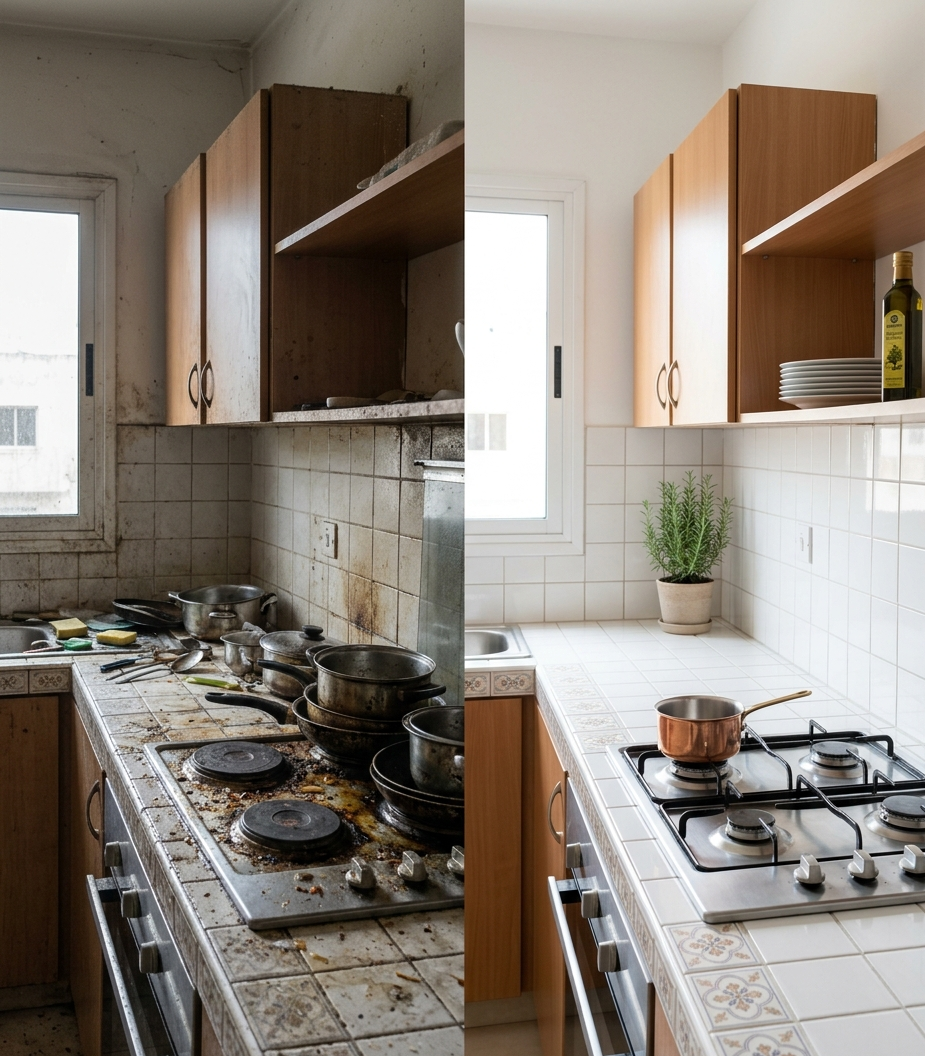
Before & After — Full deep clean, Beirut apartment
[Insert before/after image here]
Before & After — Full Apartment Deep Clean, Beirut Clean
What Regular Cleaning Covers
To understand the gap, it helps to be specific about what a regular cleaning session actually includes — and what it does not.
A standard weekly or bi-weekly clean typically covers:
- Sweeping and mopping floors
- Wiping down kitchen counters and the stovetop surface
- Cleaning the toilet, sink, and visible bathroom surfaces
- Dusting accessible furniture surfaces
- Emptying bins
- Wiping mirrors and glass
This is the appropriate scope for maintenance cleaning. It keeps the home functional and presentable. What it does not address is the layer beneath the surface — where bacteria, mold, and particulate contamination accumulate without becoming immediately visible.
What Deep Cleaning Covers That Regular Cleaning Does Not
A professional deep clean operates on a different checklist entirely. The areas that distinguish it from regular cleaning include:
Kitchen
The inside and outside of all cabinets. The area behind the refrigerator and under the stove. The oven interior. The extractor fan filter. The space between appliances. Grout lines on tile walls. The inside of the microwave and any other appliances. The underside of shelves.

Bathrooms
The grout between all tiles, including walls. The seal around the bathtub, shower tray, and sink — where mold establishes itself and is difficult to remove without the right products. The inside of the toilet cistern. Behind and beneath the toilet. The drain.


Living and sleeping areas
The top of wardrobes, shelves, and ceiling fixtures. Baseboards along all walls. The area behind and beneath furniture. Window tracks and frames. Doors, including the top edge and hinges. Light switches and sockets. Vents and air conditioning covers.
What requires specialist equipment
Soft furnishings — sofas, armchairs, mattresses, and carpets — require extraction equipment to be cleaned properly. These cannot be addressed through surface wiping, and are typically treated as a separate service from a standard deep clean.
The areas a deep clean addresses are not visible during a regular inspection of the home. They only become apparent when a professional team works through them systematically — and the difference is consistently striking, even in homes that are maintained carefully between cleans.


The Beirut Factor
The argument for regular deep cleaning is strong in any city. In Beirut, it is considerably stronger.
The city’s combination of construction dust, sea salt, diesel particulate matter, and high humidity creates conditions where contamination accumulates faster and penetrates deeper than in most urban environments. Grout discolors quickly. Mold establishes itself in bathroom seals within weeks. Kitchen surfaces exposed to cooking and Beirut’s dusty air develop a film that standard cleaning products do not fully remove.
The practical implication is that the cleaning interval appropriate for a Beirut apartment is shorter than what would be adequate elsewhere. A deep clean every six months might be sufficient in a less demanding environment. For most Beirut apartments, three to four months is a more realistic interval.
| Task | Regular cleaning | Deep cleaning |
|---|---|---|
| Floor cleaning | Sweep and mop visible area | Includes edges, baseboards, under furniture |
| Kitchen surfaces | Wipe counters and stovetop | Includes inside cabinets, behind appliances, oven interior |
| Bathroom | Toilet, sink, visible surfaces | Includes grout, seals, cistern, behind toilet |
| Windows | Wipe glass | Includes tracks, frames, exterior glass |
| Walls and doors | Not typically included | Wipe down, including tops of doors and frames |
| Soft furnishings | Not included | Requires extraction equipment — separate service |
| Air conditioning | Not included | Clean covers and accessible filters |
| Time required | 1–2 hours (standard apartment) | 4–6 hours (standard apartment, professional team) |
How to Know When Your Home Needs a Deep Clean
The signs are not always obvious, because deep contamination accumulates gradually. The following indicators suggest a deep clean is overdue:
- The bathroom grout has discolored and does not respond to regular cleaning
- There is a persistent smell in the kitchen that does not clear after cooking ventilation
- Soft furnishings carry an odor that does not resolve after airing
- Dust reappears on surfaces within one or two days of cleaning
- There is visible mold in bathroom seals or in corners near windows
- The apartment has not had a full clean since a renovation or construction project nearby
- New tenants are moving in, or a property is being prepared for rental
None of these are signs of negligence. They are signs that regular cleaning has reached its natural limit and a more thorough approach is needed.
Frequently Asked Questions
How long does a deep clean take compared to a regular clean?
A regular clean of a two-bedroom Beirut apartment typically takes one to two hours. A full deep clean of the same apartment, conducted by a professional team of three or four, takes between four and six hours. This reflects the scope difference — deep cleaning covers significantly more area and requires more product time and technical attention.
How often should I deep clean my Beirut apartment?
For most Beirut apartments, a deep clean every three to four months is appropriate. Apartments with higher dust exposure — lower floors, proximity to construction, older building stock — may benefit from more frequent deep cleaning. The interval for soft furnishing extraction is typically once or twice per year depending on use and exposure.
Can I do a deep clean myself, or does it require a professional team?
The surface components of a deep clean — floors, kitchen cabinets, bathroom grout, walls — are achievable without professional equipment if approached methodically and given adequate time. The areas that genuinely require professional equipment are soft furnishings and carpets, which need extraction machines, and high exterior windows. A practical approach for many households is to handle the surface deep clean and bring in professionals for furnishings and glass.
What is the difference between a deep clean and a move-in or move-out clean?
A move-in or move-out clean is essentially a comprehensive deep clean applied to an empty property. Because the space is unoccupied, teams can access all areas without moving furniture, which typically results in a more thorough outcome. The checklist is similar, but the empty environment allows for more complete coverage. Many landlords and tenants in Beirut request these specifically before or after tenancy.
Does deep cleaning include furniture and carpet cleaning?
Standard deep cleaning covers hard surfaces, kitchen, bathrooms, windows, and general interior areas. Furniture and carpet extraction cleaning requires specialist equipment — Karcher extraction machines — and is typically quoted and scheduled as a separate service. Many clients combine both on the same visit.
What products does Beirut Clean use for deep cleaning?
Beirut Clean uses professional-grade, eco-friendly cleaning products appropriate for each surface type. Bathroom treatments use targeted descaling and mold-inhibiting products. Kitchen degreasers are food-safe. All products used on soft furnishings and in enclosed spaces are selected to be safe for households with children and pets.
How much does a deep clean cost in Beirut?
Beirut Clean prices deep cleaning at $1.50 to $2.00 per square meter depending on the condition of the property and the scope of work required. A standard 150-square-meter apartment would typically fall between $225 and $300. Contact us via WhatsApp for a precise quote based on your specific situation.
Beirut Clean provides professional deep cleaning services across Beirut and Greater Beirut. Contact us to discuss what your apartment needs and receive a transparent quote.Contact us on WhatsApp

Leave a Reply