
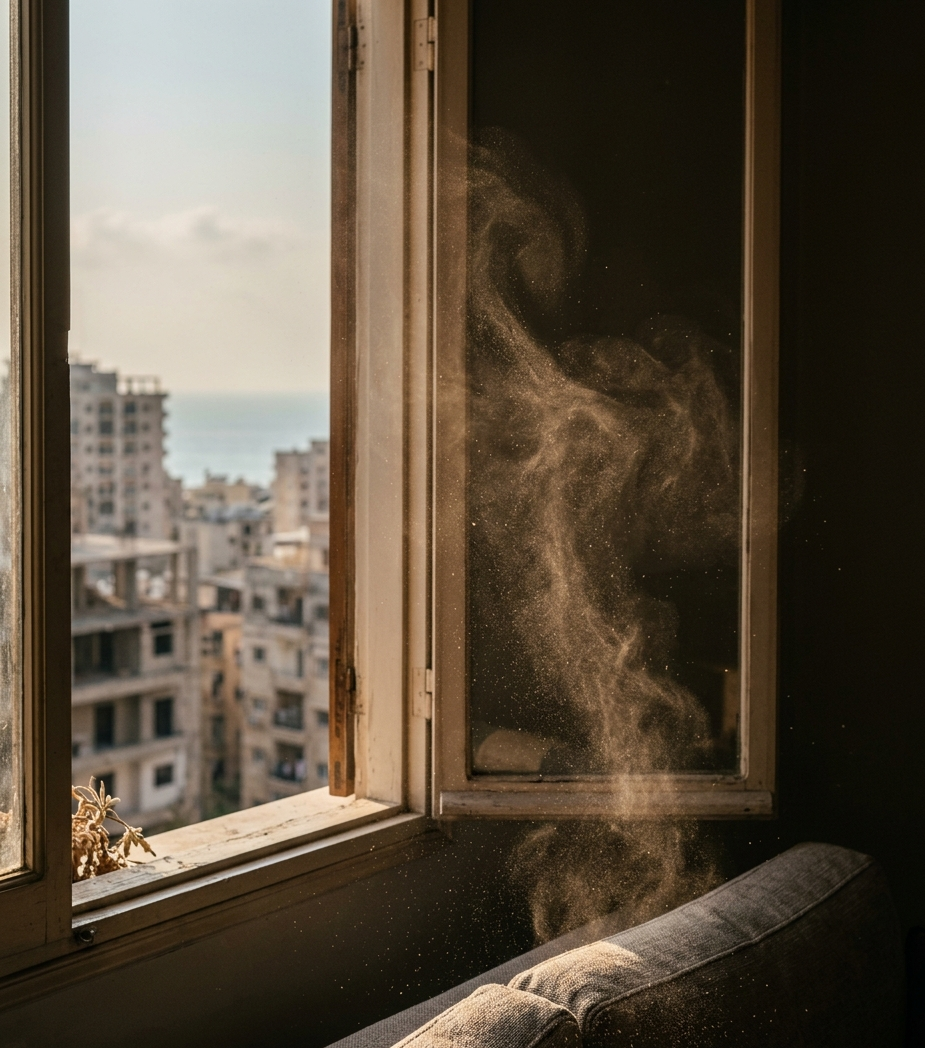
Beirut Dust and Your Home: What It Is, Why It Matters, and How to Deal With It
Most apartments in Beirut accumulate dust faster than their owners expect. The standard response is to vacuum more frequently. But frequency alone does not solve the problem — because Beirut dust is not ordinary household dust.
What Makes Beirut Dust Different
Household dust in most cities consists primarily of dead skin cells, fabric fibers, and pollen. These are manageable with regular cleaning. In Beirut, the composition is considerably more complex.
The city sits at the intersection of several pollution sources that have no equivalent in most urban environments. Sea salt carried inland from the Mediterranean coast deposits on surfaces and embeds in fabrics. Diesel emissions from the generator infrastructure — which operates at a scale unique to Lebanon — introduce fine particulate matter into indoor environments even through closed windows. Construction activity across the city, ongoing and intensive, continuously generates concrete and silica particles.
In apartments near the port area, assessments conducted after the 2020 explosion identified residual contamination that continued to affect indoor air quality in subsequent years. This is a specific factor that applies to a significant portion of Beirut’s residential stock.
The result is a dust composition that is heavier, stickier, and more chemically complex than what most cleaning products and methods are designed to handle.
Before & After — Dust accumulation on soft furnishings, Beirut apartment
[Insert before/after image here]
Before & After — Dust Accumulation, Beirut Clean
Where Dust Accumulates in a Beirut Home
Understanding where contaminated particles settle is the first step to addressing them effectively. The answer is not limited to visible surfaces.
Soft furnishings
Sofas, armchairs, and carpets act as filters. They trap particles that enter the room and hold them inside the fabric structure. A sofa in a Beirut apartment that faces a window or sits near an air conditioning unit will accumulate significant particulate matter within weeks — most of which is invisible to the eye but detectable through smell and through the dullness that gradually affects fabric color.


Window tracks and frames
Beirut’s combination of wind direction, sea proximity, and pollution creates heavy deposits in window tracks. These are rarely cleaned during standard housekeeping and become a reservoir of particles that re-enter the room every time a window is opened or closed.
Air conditioning filters and vents
Split units, which are standard in Beirut apartments, recirculate indoor air. When filters are not cleaned regularly, they distribute accumulated particles — including mold spores encouraged by the city’s humidity — throughout the room during operation.
Behind and beneath furniture
The areas behind refrigerators, washing machines, sofas, and wardrobes receive no airflow and no cleaning attention in most households. In a city with Beirut’s dust load, these spaces accumulate dense concentrations over time.
Why Standard Vacuuming Is Not Enough
This is the part that most cleaning guides skip.
A standard household vacuum cleaner, when used on a sofa or carpet, lifts particles from the surface layer. It does not reach the particles embedded in the lower fabric layers. Worse, the suction action can disturb fine particles and temporarily suspend them in the air before they settle again.
The specific problem with Beirut dust is its weight and adhesion. Sea salt and construction particles are denser and stickier than standard household dust. They bond to fabric fibers at a level that surface vacuuming does not reach.
Professional extraction cleaning operates differently. Rather than applying suction to the surface, extraction machines inject a controlled flow into the fabric and simultaneously extract it, pulling contaminated particles out from inside the material rather than redistributing them across it.
Talk to Us on WhatsApp
Get a quote, book a cleaning, or ask any question — our team replies fast, 7 days a week.
+961 70 879 233 · Replies 7 days a week · No account needed
Health Implications
The health case for addressing dust properly is not about extreme risk — it is about chronic, low-level impact that accumulates over time.
Respiratory sensitivity is the most immediate concern. Fine particulate matter — classified as PM2.5 by environmental agencies — is small enough to bypass the upper respiratory system and reach the lungs directly. Beirut’s air quality measurements frequently exceed WHO guidelines for PM2.5, and indoor environments in heavily affected areas can reflect or exceed outdoor levels.
Children and elderly residents are disproportionately affected. Children spend more time at floor level and in contact with soft furnishings. Elderly residents with pre-existing respiratory conditions are more sensitive to ongoing particulate exposure.
Allergic responses — including rhinitis, skin reactions, and asthma exacerbation — are also commonly associated with dust mite populations, which thrive in soft furnishings in humid environments like Beirut. These are not addressed by surface cleaning.
What Effective Cleaning Actually Looks Like
A cleaning approach adequate for Beirut’s environment requires addressing both surfaces and embedded contamination.
For hard surfaces — floors, counters, window tracks, baseboards — a thorough wipe-down with appropriate products removes accumulated deposits. This should be done methodically and include the areas most commonly skipped: the top of kitchen cabinets, behind appliances, and inside window frames.
For soft furnishings and carpets, extraction cleaning is the appropriate method. This applies to sofas, armchairs, carpets, and in some cases mattresses. The frequency depends on the apartment’s exposure — units on lower floors in heavily trafficked areas require more frequent attention than higher-floor apartments in quieter streets.


Air conditioning filters should be cleaned every four to six weeks during heavy-use periods. This is a simple task that has a measurable impact on the air quality of the entire apartment.
Windows and their tracks should be cleaned as part of any deep cleaning session, not treated as a separate or optional task. The track deposits re-enter the room continuously if left unaddressed.
A full deep clean of a Beirut apartment — one that addresses all these areas systematically — is not a weekly task. But it is a necessary one, typically every three to four months for most residential units, and more frequently in apartments with high dust exposure.
Frequently Asked Questions
How often should a Beirut apartment be deep cleaned?
For most apartments in Beirut, a thorough deep clean every three to four months is appropriate. Apartments on lower floors, near construction sites, or in areas with heavy traffic may benefit from more frequent attention. Soft furnishings specifically — sofas and carpets — typically need professional extraction cleaning once or twice per year.
Is Beirut dust harmful to health?
The particulate matter in Beirut’s dust — including construction particles and diesel emissions — can contribute to respiratory irritation with prolonged exposure. The risk is not acute for most healthy adults, but is more significant for children, elderly residents, and those with existing respiratory conditions. Maintaining clean indoor air through proper cleaning and ventilation reduces this exposure meaningfully.
Does closing windows prevent dust from entering?
Closing windows reduces but does not eliminate dust entry. Fine particles enter through door gaps, ventilation systems, and on clothing and shoes. Air conditioning units that recirculate indoor air without filtration can also redistribute settled particles. A combination of ventilation management and regular deep cleaning is more effective than window closure alone.
What is the difference between steam cleaning and extraction cleaning for sofas?
Steam cleaning uses heat and moisture to loosen surface contamination. Extraction cleaning uses controlled fluid injection and simultaneous extraction to physically remove particles from inside the fabric. For Beirut’s dust composition — which includes heavy, adherent particles — extraction is generally more effective. Steam can also increase moisture in fabrics, which may encourage mold growth in humid conditions.
How long does a deep clean of a Beirut apartment take?
A thorough deep clean of a standard two-bedroom apartment in Beirut, covering all surfaces, kitchen, bathrooms, and window tracks, typically takes between four and six hours with a professional team. Larger apartments or those with significant buildup will require more time. Soft furnishing extraction is typically quoted and scheduled separately.
Can I do an effective deep clean myself?
Surface deep cleaning — floors, counters, bathrooms, and kitchen — is achievable without professional equipment if done methodically and thoroughly. The areas that genuinely require professional equipment are soft furnishings and carpets, which require extraction machines to address embedded contamination, and high windows or facade areas that require safety equipment. For most apartments, a combination of self-cleaning for surfaces and professional extraction for furnishings is a reasonable approach.
Does Beirut Clean offer services across all Beirut neighborhoods?
Beirut Clean operates across Beirut and Greater Beirut, including Achrafieh, Hamra, Verdun, Mar Mikhael, Gemmayze, Ras Beirut, Badaro, Baabda, Hazmieh, Hadath, Chiyah, and surrounding areas. Contact us via WhatsApp to confirm availability for your specific location.
Beirut Clean provides professional deep cleaning and extraction services across Beirut and Greater Beirut. Contact us to discuss your apartment’s specific needs.

Leave a Reply