
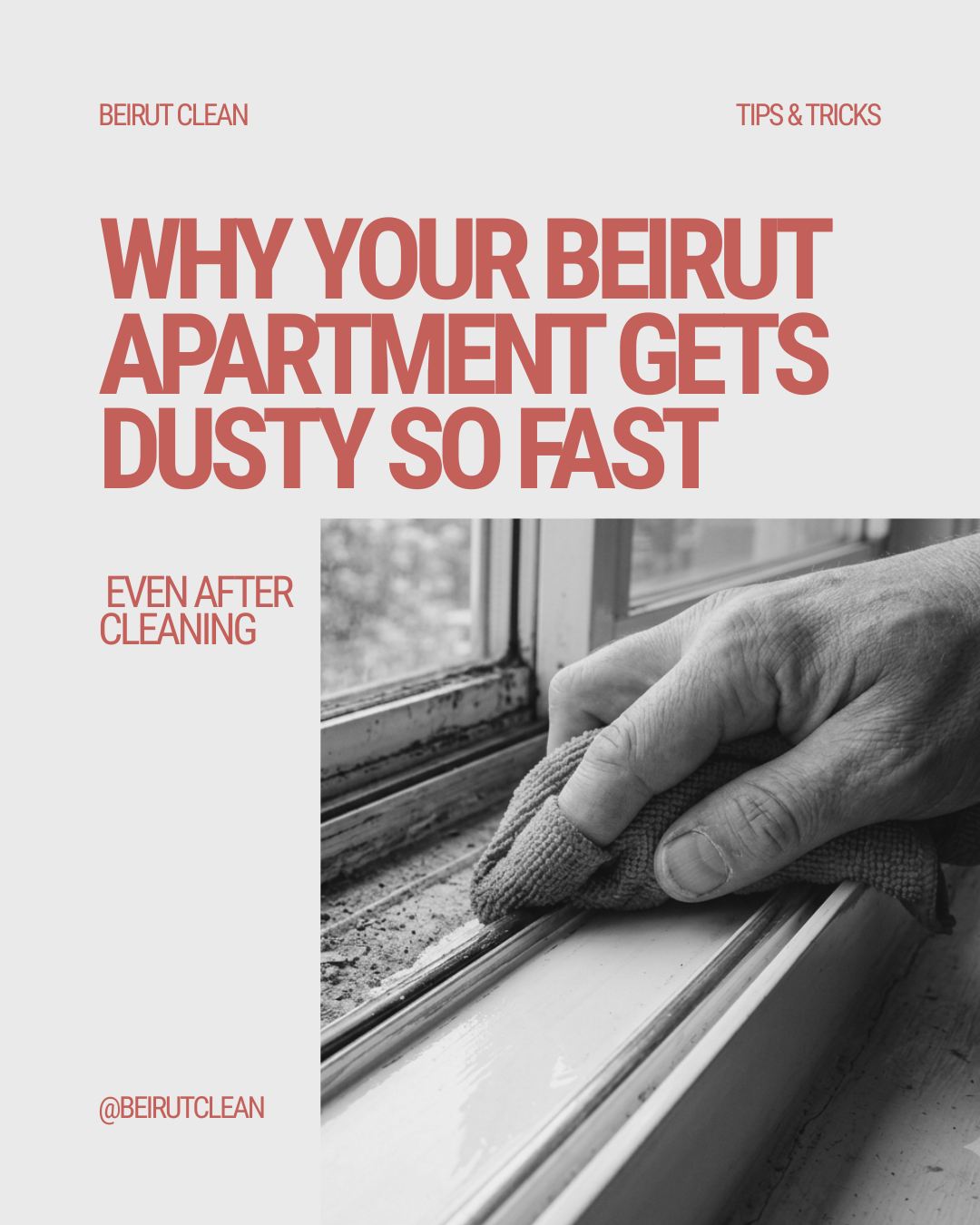
Why Your Beirut Apartment Gets Dusty So Fast, Even After Cleaning
Your Beirut apartment gets dusty so fast because dust is entering from several directions at the same time. Traffic pollution, construction dust, sea humidity, balcony exposure, old building gaps, shoes, fabrics, carpets, and poor ventilation all contribute to fast dust buildup inside the home.
This is why many people clean their apartment and still feel, only two or three days later, that the furniture, floors, window tracks, and balcony areas are dusty again.
The problem is not always poor cleaning. In Beirut, the environment itself makes dust management harder. Apartments are exposed to fine particles from roads, construction work, nearby buildings, open windows, AC units, and humidity. Once dust enters the home, it settles on visible surfaces, hides behind furniture, sticks to fabric, collects in carpets, and builds up inside window frames and corners.
The real solution is not cleaning harder once in a while. The solution is understanding where the dust comes from, then using the right type of cleaning for each part of the home. Regular housekeeping controls daily dust. Deep cleaning removes hidden buildup. Sofa and carpet shampooing removes dust trapped inside fabric. Window and track cleaning reduces the dust that keeps returning from openings.
This guide explains why Beirut apartments get dusty so quickly and what you can do to keep your home cleaner for longer.

The Short Answer: Why Is My Beirut Apartment Always Dusty?
A Beirut apartment becomes dusty quickly because outdoor dust, humidity, pollution, construction residue, and indoor fabric particles combine inside a closed living space.
The most common sources are:
- traffic and road pollution
- construction dust from nearby buildings
- balcony and window exposure
- sea humidity that makes dust stick to surfaces
- AC units and poor ventilation
- shoes bringing dirt from outside
- carpets, sofas, curtains, and mattresses holding dust
- old window frames and tracks collecting debris
- irregular cleaning routines
- hidden dust behind furniture and appliances
Even if the apartment looks clean after mopping and wiping, dust may still be sitting inside fabrics, under furniture, behind doors, along baseboards, and inside window tracks. When air moves through the apartment, that hidden dust spreads again.
That is why many homes in Beirut need a mix of regular cleaning and periodic deep cleaning, not only occasional surface cleaning.
Why Dust Builds Up Faster in Beirut Homes
Dust exists everywhere, but Beirut has conditions that make it more visible and harder to control.
Many apartments are close to busy streets, construction activity, commercial areas, old buildings, and coastal humidity. These factors affect the inside of the home even when doors and windows are closed most of the day.

Fine dust enters through small openings around:
- balcony doors
- window frames
- AC openings
- building entrances
- elevator areas
- shoe traffic
- ventilation gaps
Once inside, dust settles quickly on floors, shelves, tables, electronics, and fabric surfaces.
This is why homes near main roads, active construction sites, or open balconies often feel dusty again shortly after cleaning.
Dust Is Not Only What You See on the Table
Most people notice dust when it appears on a black table, glass surface, TV stand, or floor. But visible dust is only part of the problem.
A lot of dust hides in areas that are not cleaned during normal weekly cleaning, such as:
- behind sofas
- under beds
- under carpets
- behind refrigerators
- on top of cabinets
- inside window tracks
- on ceiling fan blades
- around AC vents
- along baseboards
- inside curtains
- inside upholstery fibers
When these areas are ignored for weeks or months, they become storage zones for dust. Then every time someone opens a window, turns on the AC, moves furniture, or walks through the room, some of that dust returns to visible surfaces.
This is one reason why an apartment can feel dusty even when it was cleaned recently.
The Role of Construction Dust in Beirut Apartments
Construction and renovation work are major reasons for dust buildup in Beirut.
Even if the work is not happening inside your apartment, nearby drilling, sanding, cement work, tile cutting, and building repairs can release fine particles into the surrounding environment.
This dust can enter the home through:
- balcony doors
- open windows
- building staircases
- shared corridors
- AC openings
- clothing and shoes
Construction dust is more difficult to remove than ordinary household dust because it is often finer and heavier. It can settle inside tracks, corners, cabinets, floor grout, balcony edges, and hidden surfaces.
After renovation work, a quick cleaning is usually not enough. The apartment may need post-renovation deep cleaning because the dust spreads beyond the visible work area.
Signs that construction dust is still present include:
- floors feel rough after mopping
- white or gray powder appears again after wiping
- window tracks are filled with residue
- cabinets feel dusty inside
- AC vents release dust
- balcony doors and frames look dirty again quickly
In this case, regular housekeeping alone will not solve the problem. A proper deep cleaning is needed first, then regular maintenance can keep the apartment under control.
Humidity Makes Dust Stick to Surfaces
Beirut’s coastal humidity makes dust more difficult to manage.
When the air is humid, dust does not always behave like dry powder. It can stick to glass, floors, bathroom surfaces, kitchen cabinets, window frames, and fabrics. This is why some homes feel “heavy” or not fully fresh even after basic cleaning.
Humidity also affects bathrooms, kitchens, wardrobes, and closed rooms. Moisture can make surfaces attract more residue, especially when ventilation is weak.
This is why cleaning in Beirut is not only about removing visible dust. It is also about controlling the buildup that forms when dust, moisture, grease, and poor airflow combine.
Areas most affected by humidity include:
- bathrooms
- kitchens
- window frames
- balcony doors
- wardrobes
- carpets
- mattresses
- fabric sofas
- curtains
A regular cleaning schedule helps reduce this buildup before it becomes harder to remove.

Poor Ventilation Makes Dust Feel Worse
Many apartments in Beirut are not ventilated consistently.
Power cuts, closed windows, pollution outside, hot weather, and AC use can all reduce fresh air circulation. When air does not move properly, dust and odors remain trapped indoors for longer.
This is especially noticeable in:
- bedrooms
- bathrooms without strong ventilation
- kitchens
- closed living rooms
- apartments that stay shut during the day
When ventilation is poor, dust settles more heavily on furniture and floors. Fabrics also hold odors and particles for longer.
This is one reason why a home may look clean but still feel stale.
Better cleaning helps, but ventilation habits matter too. Opening windows at the right times, cleaning AC filters, and keeping fabric surfaces maintained can make a noticeable difference.
Sofas, Carpets, Curtains, and Mattresses Hold Dust
Dust does not only sit on hard surfaces.
Fabric is one of the biggest dust collectors inside any home. Sofas, carpets, curtains, cushions, mattresses, and rugs can hold dust deep inside their fibers.
This is important because fabric dust is not always visible. A sofa may look clean, but still hold:
- fine dust
- body oils
- food residue
- allergens
- odors
- moisture
- dust mites
Vacuuming helps, but it does not always remove what is embedded deep inside upholstery or carpet fibers.
This is why sofa and carpet shampooing are important for homes that feel dusty even after regular cleaning. Professional injection-extraction cleaning helps remove dirt and residue from deeper layers of the fabric, not only from the surface.
Homes with children, pets, smokers, or heavy living room use often need upholstery and carpet cleaning more frequently.
Window Tracks Are One of the Most Ignored Dust Sources
Many people clean the glass but forget the window tracks.
In Beirut, window tracks collect a surprising amount of dust, sand, dead insects, pollution residue, and moisture. When wind enters through the window, this dust can move back into the apartment.
Dirty window tracks can make a clean room dusty again faster than expected.
Professional window cleaning should include more than glass polishing. It should cover:
- glass
- frames
- tracks
- sills
- screens
- accessible edges
This is especially important for apartments with balconies, sea exposure, or windows facing busy roads.
If your windows become dirty quickly after cleaning, the problem may not be the glass. It may be the tracks, frames, and surrounding dust buildup.
Shoes Bring Outdoor Dust Inside
A large amount of household dust comes from outside.
Shoes carry dirt, fine particles, and street residue into the home. This is especially true in Beirut, where sidewalks, parking areas, staircases, and building entrances often collect dust quickly.
The most affected areas are usually:
- entrance floors
- corridors
- carpets near the door
- living room paths
- balcony entrances
A simple habit such as keeping outdoor shoes near the entrance can reduce dust spread. Regular mopping near the entrance also helps.
For families with children or heavy daily movement, housekeeping once or twice per week can make a noticeable difference.
AC Units and Filters Can Spread Dust
Air conditioning is part of daily life in many Beirut apartments, especially during warm months.
But AC units can also spread dust if filters and vents are not cleaned regularly. Dust collects inside filters, covers, and vents. When the AC turns on, particles can circulate through the room.
Signs that your AC may be contributing to dust include:
- dust appearing near the unit
- musty smell when AC starts
- visible dust on vent covers
- black or gray marks around airflow areas
- more dust in bedrooms after AC use
Regular cleaning of AC filters and vent covers helps reduce dust circulation. During deep cleaning, AC exterior covers and accessible vents should be cleaned as part of the full apartment reset.

Why Mopping Alone Does Not Solve Dust
Many people respond to dust by mopping more often. Mopping helps, but it is not enough when dust is coming from multiple sources.
Mopping removes dust from floors, but it does not remove dust from:
- window tracks
- sofa fibers
- curtains
- AC vents
- high shelves
- baseboards
- under furniture
- mattress surfaces
- door frames
- walls and switches
If these areas remain dusty, floors will become dusty again quickly.
A cleaner home requires a top-to-bottom method. Dust should be removed from higher surfaces first, then furniture, then lower surfaces, then floors. If floors are cleaned first, dust from shelves, walls, and furniture can fall again afterward.
This is why structured cleaning matters. The order of work affects the final result.
How Often Should a Beirut Apartment Be Cleaned?
There is no single schedule that works for every home. The right frequency depends on the apartment size, number of residents, location, lifestyle, and level of dust exposure.
A practical schedule for Beirut apartments is:
Light-use apartment
One housekeeping visit per week may be enough for a small apartment with one or two residents.
Family home
One to two housekeeping visits per week is usually more realistic, especially when children are present.
Apartment near a main road or construction site
More frequent dust control may be needed, especially around windows, balconies, and floors.
Apartment after renovation
A full post-renovation deep cleaning should be done before regular housekeeping begins.
Apartment with carpets, sofas, and curtains
Upholstery and carpet cleaning should be added periodically because fabric holds dust deeply.
Apartment that has not been cleaned professionally for months
Start with deep cleaning, then continue with housekeeping.
The main rule is simple: regular cleaning controls daily dust, but deep cleaning removes the buildup that regular cleaning cannot reach.
Regular Housekeeping vs Deep Cleaning: Which One Do You Need?
If your apartment becomes dusty a few days after cleaning but does not have heavy buildup, you probably need regular housekeeping.
If your apartment feels dusty no matter how much you clean, you probably need deep cleaning first.
Choose housekeeping if:
- the apartment is generally in good condition
- you need weekly maintenance
- dust returns quickly but is not heavy
- the kitchen and bathrooms need routine care
- you want the home to stay organized
Choose deep cleaning if:
- there is dust behind furniture
- kitchen grease has built up
- bathrooms have limescale or grout buildup
- floors feel dirty even after mopping
- cabinets, tracks, and corners need detailed cleaning
- the apartment has not been cleaned deeply for months
Choose sofa and carpet shampooing if:
- the home still feels dusty after cleaning
- sofas have odor or stains
- carpets look dull
- children or pets use the furniture daily
- fabrics feel heavy or not fresh
Choose window cleaning if:
- dust collects near frames and balcony doors
- glass becomes cloudy quickly
- tracks are full of debris
- screens look dusty
- the apartment needs more natural light
Most Beirut homes need a combination of these services at different times.
How Beirut Clean Helps Control Dust Properly
Beirut Clean approaches dust as a full-home maintenance problem, not only a surface cleaning issue.
The right service depends on the condition of the apartment.
For weekly maintenance
Housekeeping helps control daily dust, floors, surfaces, kitchens, bathrooms, and general organization.
For hidden buildup
Deep cleaning resets the apartment by cleaning neglected areas, corners, baseboards, kitchen grease, bathroom buildup, and hidden dust zones.
For sofas and carpets
Professional shampooing removes dust, residue, and odors trapped inside fabrics.
For windows and balcony areas
Window cleaning removes dust from glass, frames, tracks, screens, and accessible edges.
The goal is to reduce the sources of dust, not only wipe the visible layer.
Practical Tips to Keep Your Beirut Apartment Cleaner for Longer
You cannot stop dust completely, but you can reduce how fast it builds up.
Clean from top to bottom
Start with high shelves, wall edges, fans, and furniture. Clean floors last.
Keep shoes near the entrance
This reduces street dust spreading into living areas.
Clean window tracks regularly
Dirty tracks can keep sending dust back into the apartment.
Wash or vacuum fabric surfaces
Sofas, carpets, rugs, and curtains hold dust deeply.
Clean AC filters
Dusty filters can spread particles through the room.
Use regular housekeeping
Small, consistent cleaning prevents large buildup.
Schedule deep cleaning every few months
Deep cleaning removes the hidden dust that regular cleaning misses.
Avoid ignoring balconies
Balconies are one of the biggest dust entry points in Beirut apartments.
Do not only wipe visible surfaces
Dust hidden under furniture and along edges will come back quickly if ignored.
When Dust Becomes a Sign That Your Home Needs Deep Cleaning
Dust is normal. But if it keeps returning heavily, it may be a sign that surface cleaning is no longer enough.
Your home may need deep cleaning if:
- floors feel dusty right after mopping
- furniture gets dusty within one or two days
- window tracks are filled with dirt
- bathrooms feel humid and stained
- kitchen cabinets feel greasy
- there is dust behind sofas and beds
- AC vents look dirty
- the home smells closed or heavy
- carpets and sofas feel dull or dusty
In this situation, housekeeping can help after the apartment is reset, but it may not solve the problem alone.
A deep cleaning service removes the hidden dust sources first. Then regular housekeeping helps maintain the result.
Why Dust Control Matters for Comfort and Indoor Air Quality
Dust affects how a home feels.
A dusty apartment can feel:
- dull
- heavy
- uncomfortable
- less fresh
- harder to maintain
- visually messy even after cleaning
Dust also interacts with indoor air quality because particles settle on surfaces, fabrics, bedding, carpets, and upholstered furniture.
This is especially important for homes with:
- children
- elderly residents
- allergy-sensitive people
- pets
- carpets
- heavy fabric furniture
- poor ventilation
Cleaning cannot replace proper ventilation or medical care for allergies, but it can reduce the amount of dust and residue inside the living environment.
A clean home is not only about appearance. It is about comfort, routine, and the feeling of control inside your space.
The Best Cleaning Plan for a Dusty Beirut Apartment
If your apartment gets dusty fast, the best approach is usually a cleaning plan, not a one-time reaction.
A practical plan looks like this:
Step 1: Start with deep cleaning if there is hidden buildup
This is important if the apartment has not been professionally cleaned for months, or if dust is trapped behind furniture, inside tracks, and around corners.
Step 2: Add regular housekeeping
Housekeeping keeps floors, surfaces, kitchens, bathrooms, and rooms under control every week.
Step 3: Clean sofas and carpets periodically
Fabric holds dust deeply. Shampooing helps remove what vacuuming cannot.
Step 4: Clean windows, frames, and tracks
This reduces dust entering and sitting near openings.
Step 5: Maintain entrances and balconies
These areas bring in dust from outside faster than most people expect.
This plan keeps the apartment cleaner for longer because it treats dust at the source.
Areas in Beirut Where Dust Is Especially Common
Dust buildup can happen anywhere, but some areas tend to experience it more because of traffic, density, coastal exposure, or construction activity.
Apartments may need more frequent cleaning in areas such as:
- Hamra
- Achrafieh
- Mar Mikhael
- Gemmayze
- Verdun
- Ras Beirut
- Badaro
- Baabda
- Hazmieh
- Hadath
- Chiyah
- Dahye
- Greater Beirut
The exact cleaning frequency depends on the building, floor level, balcony exposure, and how often windows are opened.
Frequently Asked Questions
Why does my apartment in Beirut get dusty so fast?
Your apartment gets dusty fast because outdoor dust, traffic pollution, construction particles, humidity, shoes, fabrics, and poor ventilation all contribute to indoor dust buildup. Dust also hides in window tracks, carpets, sofas, AC vents, and behind furniture, then returns to visible surfaces.
Does humidity make dust worse?
Yes. Humidity can make dust stick more easily to surfaces such as glass, floors, bathroom areas, kitchen cabinets, and window frames. In Beirut’s coastal climate, dust and moisture often combine, making surfaces feel less fresh even after basic cleaning.
Is regular housekeeping enough for a dusty apartment?
Regular housekeeping is enough when the apartment is already in good condition and needs weekly maintenance. If there is hidden dust behind furniture, inside tracks, or around neglected areas, deep cleaning may be needed first.
How often should I deep clean my apartment in Beirut?
Most Beirut apartments benefit from deep cleaning every three to six months, depending on dust exposure, family size, cooking habits, humidity, and whether there is nearby construction.
Why does dust come back after mopping?
Dust comes back after mopping because dust is often still present on higher surfaces, window tracks, sofas, curtains, AC vents, baseboards, and hidden corners. When air moves, that dust settles back on the floor.
Do sofas and carpets make the apartment dustier?
Sofas, carpets, curtains, and mattresses can hold dust inside their fibers. Even if they look clean, they may release dust when people sit, walk, or move around the room. Periodic shampooing helps remove deeper residue.
Should windows be cleaned as part of dust control?
Yes. Window cleaning helps because tracks, frames, screens, and balcony doors collect large amounts of dust. If these areas are ignored, dust can keep entering or spreading back into the apartment.
What is the best service if my apartment always feels dusty?
If the apartment has hidden buildup, start with deep cleaning. If the apartment is already manageable but gets dusty every few days, choose regular housekeeping. If fabrics smell dusty or feel heavy, add sofa and carpet shampooing.
Book Professional Cleaning Services in Beirut
If your Beirut apartment gets dusty too quickly, the solution is not only more mopping. The right approach is a structured cleaning plan that controls daily dust and removes hidden buildup.
Beirut Clean provides professional cleaning services across Beirut and Greater Beirut, including housekeeping, deep cleaning, sofa and carpet shampooing, and window cleaning.
For booking or consultation:
WhatsApp: +961 70 879 233
Website: www.beirutclean.com
Internal Linking Suggestions
Link this article to:
- Housekeeping Services in Beirut
- Deep Cleaning Services in Beirut
- Sofa and Carpet Cleaning in Beirut
- Window Cleaning Services in Beirut
- Post-Renovation Cleaning in Beirut
Suggested Image Placement
Image 1: After the introduction
Alt text: dusty apartment Beirut before professional cleaning
Image 2: After the section “Why Dust Builds Up Faster in Beirut Homes”
Alt text: dust buildup on furniture in Beirut apartment
Image 3: After the section “Window Tracks Are One of the Most Ignored Dust Sources”
Alt text: dusty window tracks in Beirut apartment
Image 4: Before the FAQ section
Alt text: clean apartment after deep cleaning Beirut
SEO Tags
dusty apartment Beirut, why is my apartment always dusty, house dust Beirut, apartment cleaning Beirut, housekeeping Beirut, deep cleaning Beirut, cleaning services Beirut, dust cleaning Lebanon, sofa cleaning Beirut, carpet cleaning Beirut, window cleaning Beirut, Beirut CleanURL Slug:
why-beirut-apartment-gets-dusty-fast
Meta Description:
Find out why Beirut apartments get dusty so fast and how regular cleaning, deep cleaning, and upholstery care help keep your home cleaner.
Focus Keyphrase:
dusty apartment Beirut
SEO Keywords:
dusty apartment Beirut, why is my house always dusty, apartment cleaning Beirut, deep cleaning Beirut, housekeeping Beirut, dust cleaning Lebanon, sofa cleaning Beirut, carpet cleaning Beirut, indoor dust Beirut, home cleaning Beirut
Why Your Beirut Apartment Gets Dusty So Fast, Even After Cleaning
Your Beirut apartment gets dusty so fast because dust is entering from several directions at the same time. Traffic pollution, construction dust, sea humidity, balcony exposure, old building gaps, shoes, fabrics, carpets, and poor ventilation all contribute to fast dust buildup inside the home.
This is why many people clean their apartment and still feel, only two or three days later, that the furniture, floors, window tracks, and balcony areas are dusty again.
The problem is not always poor cleaning. In Beirut, the environment itself makes dust management harder. Apartments are exposed to fine particles from roads, construction work, nearby buildings, open windows, AC units, and humidity. Once dust enters the home, it settles on visible surfaces, hides behind furniture, sticks to fabric, collects in carpets, and builds up inside window frames and corners.
The real solution is not cleaning harder once in a while. The solution is understanding where the dust comes from, then using the right type of cleaning for each part of the home. Regular housekeeping controls daily dust. Deep cleaning removes hidden buildup. Sofa and carpet shampooing removes dust trapped inside fabric. Window and track cleaning reduces the dust that keeps returning from openings.
This guide explains why Beirut apartments get dusty so quickly and what you can do to keep your home cleaner for longer.
The Short Answer: Why Is My Beirut Apartment Always Dusty?
A Beirut apartment becomes dusty quickly because outdoor dust, humidity, pollution, construction residue, and indoor fabric particles combine inside a closed living space.
The most common sources are:
- traffic and road pollution
- construction dust from nearby buildings
- balcony and window exposure
- sea humidity that makes dust stick to surfaces
- AC units and poor ventilation
- shoes bringing dirt from outside
- carpets, sofas, curtains, and mattresses holding dust
- old window frames and tracks collecting debris
- irregular cleaning routines
- hidden dust behind furniture and appliances
Even if the apartment looks clean after mopping and wiping, dust may still be sitting inside fabrics, under furniture, behind doors, along baseboards, and inside window tracks. When air moves through the apartment, that hidden dust spreads again.
That is why many homes in Beirut need a mix of regular cleaning and periodic deep cleaning, not only occasional surface cleaning.
Why Dust Builds Up Faster in Beirut Homes
Dust exists everywhere, but Beirut has conditions that make it more visible and harder to control.
Many apartments are close to busy streets, construction activity, commercial areas, old buildings, and coastal humidity. These factors affect the inside of the home even when doors and windows are closed most of the day.
Fine dust enters through small openings around:
- balcony doors
- window frames
- AC openings
- building entrances
- elevator areas
- shoe traffic
- ventilation gaps
Once inside, dust settles quickly on floors, shelves, tables, electronics, and fabric surfaces.
This is why homes near main roads, active construction sites, or open balconies often feel dusty again shortly after cleaning.
Dust Is Not Only What You See on the Table
Most people notice dust when it appears on a black table, glass surface, TV stand, or floor. But visible dust is only part of the problem.
A lot of dust hides in areas that are not cleaned during normal weekly cleaning, such as:
- behind sofas
- under beds
- under carpets
- behind refrigerators
- on top of cabinets
- inside window tracks
- on ceiling fan blades
- around AC vents
- along baseboards
- inside curtains
- inside upholstery fibers
When these areas are ignored for weeks or months, they become storage zones for dust. Then every time someone opens a window, turns on the AC, moves furniture, or walks through the room, some of that dust returns to visible surfaces.
This is one reason why an apartment can feel dusty even when it was cleaned recently.
The Role of Construction Dust in Beirut Apartments
Construction and renovation work are major reasons for dust buildup in Beirut.
Even if the work is not happening inside your apartment, nearby drilling, sanding, cement work, tile cutting, and building repairs can release fine particles into the surrounding environment.
This dust can enter the home through:
- balcony doors
- open windows
- building staircases
- shared corridors
- AC openings
- clothing and shoes
Construction dust is more difficult to remove than ordinary household dust because it is often finer and heavier. It can settle inside tracks, corners, cabinets, floor grout, balcony edges, and hidden surfaces.
After renovation work, a quick cleaning is usually not enough. The apartment may need post-renovation deep cleaning because the dust spreads beyond the visible work area.
Signs that construction dust is still present include:
- floors feel rough after mopping
- white or gray powder appears again after wiping
- window tracks are filled with residue
- cabinets feel dusty inside
- AC vents release dust
- balcony doors and frames look dirty again quickly
In this case, regular housekeeping alone will not solve the problem. A proper deep cleaning is needed first, then regular maintenance can keep the apartment under control.
Humidity Makes Dust Stick to Surfaces
Beirut’s coastal humidity makes dust more difficult to manage.
When the air is humid, dust does not always behave like dry powder. It can stick to glass, floors, bathroom surfaces, kitchen cabinets, window frames, and fabrics. This is why some homes feel “heavy” or not fully fresh even after basic cleaning.
Humidity also affects bathrooms, kitchens, wardrobes, and closed rooms. Moisture can make surfaces attract more residue, especially when ventilation is weak.
This is why cleaning in Beirut is not only about removing visible dust. It is also about controlling the buildup that forms when dust, moisture, grease, and poor airflow combine.
Areas most affected by humidity include:
- bathrooms
- kitchens
- window frames
- balcony doors
- wardrobes
- carpets
- mattresses
- fabric sofas
- curtains
A regular cleaning schedule helps reduce this buildup before it becomes harder to remove.
Poor Ventilation Makes Dust Feel Worse
Many apartments in Beirut are not ventilated consistently.
Power cuts, closed windows, pollution outside, hot weather, and AC use can all reduce fresh air circulation. When air does not move properly, dust and odors remain trapped indoors for longer.
This is especially noticeable in:
- bedrooms
- bathrooms without strong ventilation
- kitchens
- closed living rooms
- apartments that stay shut during the day
When ventilation is poor, dust settles more heavily on furniture and floors. Fabrics also hold odors and particles for longer.
This is one reason why a home may look clean but still feel stale.
Better cleaning helps, but ventilation habits matter too. Opening windows at the right times, cleaning AC filters, and keeping fabric surfaces maintained can make a noticeable difference.
Sofas, Carpets, Curtains, and Mattresses Hold Dust
Dust does not only sit on hard surfaces.
Fabric is one of the biggest dust collectors inside any home. Sofas, carpets, curtains, cushions, mattresses, and rugs can hold dust deep inside their fibers.
This is important because fabric dust is not always visible. A sofa may look clean, but still hold:
- fine dust
- body oils
- food residue
- allergens
- odors
- moisture
- dust mites
Vacuuming helps, but it does not always remove what is embedded deep inside upholstery or carpet fibers.
This is why sofa and carpet shampooing are important for homes that feel dusty even after regular cleaning. Professional injection-extraction cleaning helps remove dirt and residue from deeper layers of the fabric, not only from the surface.
Homes with children, pets, smokers, or heavy living room use often need upholstery and carpet cleaning more frequently.
Window Tracks Are One of the Most Ignored Dust Sources
Many people clean the glass but forget the window tracks.
In Beirut, window tracks collect a surprising amount of dust, sand, dead insects, pollution residue, and moisture. When wind enters through the window, this dust can move back into the apartment.
Dirty window tracks can make a clean room dusty again faster than expected.
Professional window cleaning should include more than glass polishing. It should cover:
- glass
- frames
- tracks
- sills
- screens
- accessible edges
This is especially important for apartments with balconies, sea exposure, or windows facing busy roads.
If your windows become dirty quickly after cleaning, the problem may not be the glass. It may be the tracks, frames, and surrounding dust buildup.
Shoes Bring Outdoor Dust Inside
A large amount of household dust comes from outside.
Shoes carry dirt, fine particles, and street residue into the home. This is especially true in Beirut, where sidewalks, parking areas, staircases, and building entrances often collect dust quickly.
The most affected areas are usually:
- entrance floors
- corridors
- carpets near the door
- living room paths
- balcony entrances
A simple habit such as keeping outdoor shoes near the entrance can reduce dust spread. Regular mopping near the entrance also helps.
For families with children or heavy daily movement, housekeeping once or twice per week can make a noticeable difference.
AC Units and Filters Can Spread Dust
Air conditioning is part of daily life in many Beirut apartments, especially during warm months.
But AC units can also spread dust if filters and vents are not cleaned regularly. Dust collects inside filters, covers, and vents. When the AC turns on, particles can circulate through the room.
Signs that your AC may be contributing to dust include:
- dust appearing near the unit
- musty smell when AC starts
- visible dust on vent covers
- black or gray marks around airflow areas
- more dust in bedrooms after AC use
Regular cleaning of AC filters and vent covers helps reduce dust circulation. During deep cleaning, AC exterior covers and accessible vents should be cleaned as part of the full apartment reset.
Why Mopping Alone Does Not Solve Dust
Many people respond to dust by mopping more often. Mopping helps, but it is not enough when dust is coming from multiple sources.
Mopping removes dust from floors, but it does not remove dust from:
- window tracks
- sofa fibers
- curtains
- AC vents
- high shelves
- baseboards
- under furniture
- mattress surfaces
- door frames
- walls and switches
If these areas remain dusty, floors will become dusty again quickly.
A cleaner home requires a top-to-bottom method. Dust should be removed from higher surfaces first, then furniture, then lower surfaces, then floors. If floors are cleaned first, dust from shelves, walls, and furniture can fall again afterward.
This is why structured cleaning matters. The order of work affects the final result.
How Often Should a Beirut Apartment Be Cleaned?
There is no single schedule that works for every home. The right frequency depends on the apartment size, number of residents, location, lifestyle, and level of dust exposure.
A practical schedule for Beirut apartments is:
Light-use apartment
One housekeeping visit per week may be enough for a small apartment with one or two residents.
Family home
One to two housekeeping visits per week is usually more realistic, especially when children are present.
Apartment near a main road or construction site
More frequent dust control may be needed, especially around windows, balconies, and floors.
Apartment after renovation
A full post-renovation deep cleaning should be done before regular housekeeping begins.
Apartment with carpets, sofas, and curtains
Upholstery and carpet cleaning should be added periodically because fabric holds dust deeply.
Apartment that has not been cleaned professionally for months
Start with deep cleaning, then continue with housekeeping.
The main rule is simple: regular cleaning controls daily dust, but deep cleaning removes the buildup that regular cleaning cannot reach.
Regular Housekeeping vs Deep Cleaning: Which One Do You Need?
If your apartment becomes dusty a few days after cleaning but does not have heavy buildup, you probably need regular housekeeping.
If your apartment feels dusty no matter how much you clean, you probably need deep cleaning first.
Choose housekeeping if:
- the apartment is generally in good condition
- you need weekly maintenance
- dust returns quickly but is not heavy
- the kitchen and bathrooms need routine care
- you want the home to stay organized
Choose deep cleaning if:
- there is dust behind furniture
- kitchen grease has built up
- bathrooms have limescale or grout buildup
- floors feel dirty even after mopping
- cabinets, tracks, and corners need detailed cleaning
- the apartment has not been cleaned deeply for months
Choose sofa and carpet shampooing if:
- the home still feels dusty after cleaning
- sofas have odor or stains
- carpets look dull
- children or pets use the furniture daily
- fabrics feel heavy or not fresh
Choose window cleaning if:
- dust collects near frames and balcony doors
- glass becomes cloudy quickly
- tracks are full of debris
- screens look dusty
- the apartment needs more natural light
Most Beirut homes need a combination of these services at different times.
How Beirut Clean Helps Control Dust Properly
Beirut Clean approaches dust as a full-home maintenance problem, not only a surface cleaning issue.
The right service depends on the condition of the apartment.
For weekly maintenance
Housekeeping helps control daily dust, floors, surfaces, kitchens, bathrooms, and general organization.
For hidden buildup
Deep cleaning resets the apartment by cleaning neglected areas, corners, baseboards, kitchen grease, bathroom buildup, and hidden dust zones.
For sofas and carpets
Professional shampooing removes dust, residue, and odors trapped inside fabrics.
For windows and balcony areas
Window cleaning removes dust from glass, frames, tracks, screens, and accessible edges.
The goal is to reduce the sources of dust, not only wipe the visible layer.
Practical Tips to Keep Your Beirut Apartment Cleaner for Longer
Time needed: 2 hours
You cannot stop dust completely, but you can reduce how fast it builds up.
- Clean from top to bottom
Start with high shelves, wall edges, fans, and furniture. Clean floors last.
- Keep shoes near the entrance
This reduces street dust spreading into living areas.
- Clean window tracks regularly
Dirty tracks can keep sending dust back into the apartment.
- Wash or vacuum fabric surfaces
Sofas, carpets, rugs, and curtains hold dust deeply.
- Clean AC filters
Dusty filters can spread particles through the room.
- Use regular housekeeping
Small, consistent cleaning prevents large buildup.
- Schedule deep cleaning every few months
Deep cleaning removes the hidden dust that regular cleaning misses.
- Avoid ignoring balconies
Balconies are one of the biggest dust entry points in Beirut apartments.
- Do not only wipe visible surfaces
Dust hidden under furniture and along edges will come back quickly if ignored.
When Dust Becomes a Sign That Your Home Needs Deep Cleaning
Dust is normal. But if it keeps returning heavily, it may be a sign that surface cleaning is no longer enough.
Your home may need deep cleaning if:
- floors feel dusty right after mopping
- furniture gets dusty within one or two days
- window tracks are filled with dirt
- bathrooms feel humid and stained
- kitchen cabinets feel greasy
- there is dust behind sofas and beds
- AC vents look dirty
- the home smells closed or heavy
- carpets and sofas feel dull or dusty
In this situation, housekeeping can help after the apartment is reset, but it may not solve the problem alone.
A deep cleaning service removes the hidden dust sources first. Then regular housekeeping helps maintain the result.
Why Dust Control Matters for Comfort and Indoor Air Quality
Dust affects how a home feels.
A dusty apartment can feel:
- dull
- heavy
- uncomfortable
- less fresh
- harder to maintain
- visually messy even after cleaning
Dust also interacts with indoor air quality because particles settle on surfaces, fabrics, bedding, carpets, and upholstered furniture.
This is especially important for homes with:
- children
- elderly residents
- allergy-sensitive people
- pets
- carpets
- heavy fabric furniture
- poor ventilation
Cleaning cannot replace proper ventilation or medical care for allergies, but it can reduce the amount of dust and residue inside the living environment.
A clean home is not only about appearance. It is about comfort, routine, and the feeling of control inside your space.
The Best Cleaning Plan for a Dusty Beirut Apartment
If your apartment gets dusty fast, the best approach is usually a cleaning plan, not a one-time reaction.
A practical plan looks like this:
Step 1: Start with deep cleaning if there is hidden buildup
This is important if the apartment has not been professionally cleaned for months, or if dust is trapped behind furniture, inside tracks, and around corners.
Step 2: Add regular housekeeping
Housekeeping keeps floors, surfaces, kitchens, bathrooms, and rooms under control every week.
Step 3: Clean sofas and carpets periodically
Fabric holds dust deeply. Shampooing helps remove what vacuuming cannot.
Step 4: Clean windows, frames, and tracks
This reduces dust entering and sitting near openings.
Step 5: Maintain entrances and balconies
These areas bring in dust from outside faster than most people expect.
This plan keeps the apartment cleaner for longer because it treats dust at the source.
Areas in Beirut Where Dust Is Especially Common
Dust buildup can happen anywhere, but some areas tend to experience it more because of traffic, density, coastal exposure, or construction activity.
Apartments may need more frequent cleaning in areas such as:
- Hamra
- Achrafieh
- Mar Mikhael
- Gemmayze
- Verdun
- Ras Beirut
- Badaro
- Baabda
- Hazmieh
- Hadath
- Chiyah
- Dahye
- Greater Beirut
The exact cleaning frequency depends on the building, floor level, balcony exposure, and how often windows are opened.
Frequently Asked Questions
Yes. Humidity can make dust stick more easily to surfaces such as glass, floors, bathroom areas, kitchen cabinets, and window frames. In Beirut’s coastal climate, dust and moisture often combine, making surfaces feel less fresh even after basic cleaning.
Your apartment gets dusty fast because outdoor dust, traffic pollution, construction particles, humidity, shoes, fabrics, and poor ventilation all contribute to indoor dust buildup. Dust also hides in window tracks, carpets, sofas, AC vents, and behind furniture, then returns to visible surfaces.
Yes. Window cleaning helps because tracks, frames, screens, and balcony doors collect large amounts of dust. If these areas are ignored, dust can keep entering or spreading back into the apartment.
Sofas, carpets, curtains, and mattresses can hold dust inside their fibers. Even if they look clean, they may release dust when people sit, walk, or move around the room. Periodic shampooing helps remove deeper residue.
Dust comes back after mopping because dust is often still present on higher surfaces, window tracks, sofas, curtains, AC vents, baseboards, and hidden corners. When air moves, that dust settles back on the floor.
Most Beirut apartments benefit from deep cleaning every three to six months, depending on dust exposure, family size, cooking habits, humidity, and whether there is nearby construction.
Regular housekeeping is enough when the apartment is already in good condition and needs weekly maintenance. If there is hidden dust behind furniture, inside tracks, or around neglected areas, deep cleaning may be needed first.
If the apartment has hidden buildup, start with deep cleaning. If the apartment is already manageable but gets dusty every few days, choose regular housekeeping. If fabrics smell dusty or feel heavy, add sofa and carpet shampooing.
Book Professional Cleaning Services in Beirut
If your Beirut apartment gets dusty too quickly, the solution is not only more mopping. The right approach is a structured cleaning plan that controls daily dust and removes hidden buildup.
Beirut Clean provides professional cleaning services across Beirut and Greater Beirut, including housekeeping, deep cleaning, sofa and carpet shampooing, and window cleaning.
For booking or consultation:
WhatsApp: +961 70 879 233
Website: www.beirutclean.com

Leave a Reply