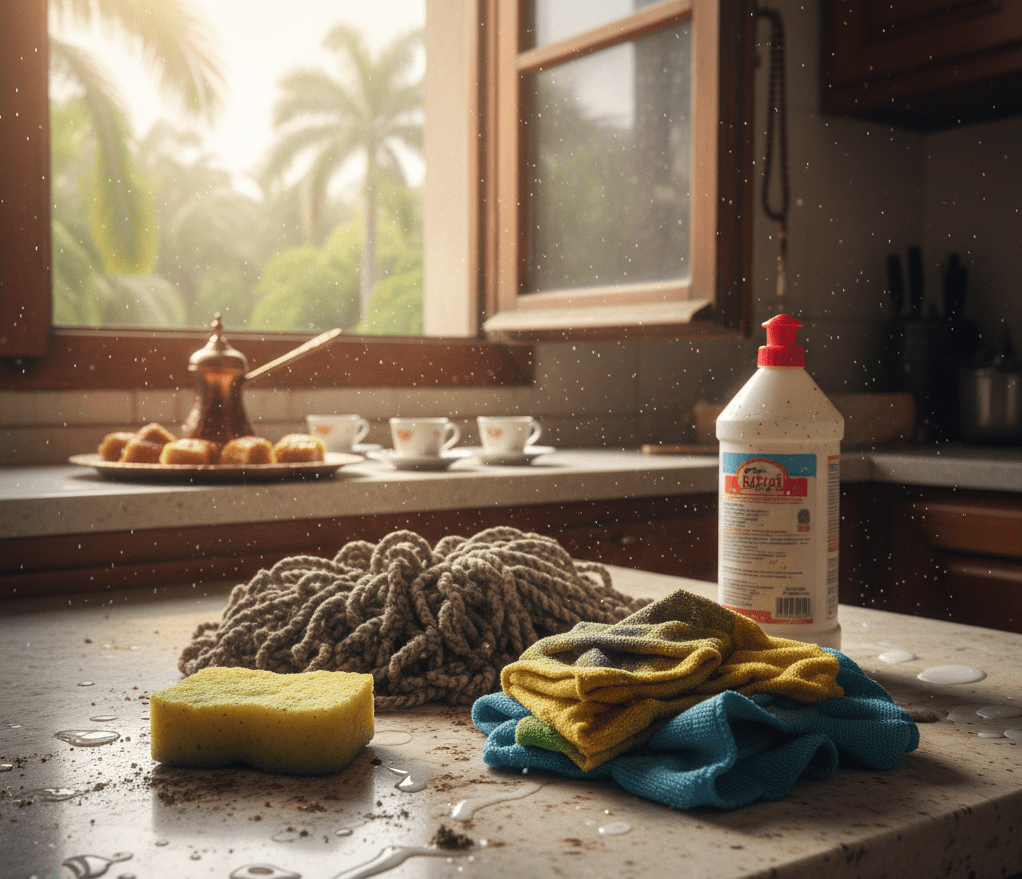
Lebanon’s climate is beautiful, but it comes with a challenge many homeowners underestimate: humidity. Whether you live in Beirut, Jounieh, Saida, Tripoli, or any coastal town, the high moisture levels in the air affect more than your comfort. Humidity accelerates the growth of bacteria, mold, and mildew inside your home—especially inside your cleaning tools. The result is simple: most Lebanese households should replace their sponges, mop heads, brushes, and microfiber cloths more often than international guidelines suggest.
Humidity slows the drying process of sponges, cloths, and mop heads. When these tools stay damp for long periods, they become the perfect environment for bacteria. A scientific study published in Scientific Reports found that a damp kitchen sponge can contain billions of bacteria even after a few days of use. In Lebanon, with heat and moisture working together, that microbial growth happens even faster.
Take the kitchen sponge as an example. International recommendations say to replace it every 7 days. In Lebanon, however, where kitchens stay warm and sponge drying is slower, a sponge can become unsafe in as little as 4–5 days. The same applies to dish brushes. Although they dry faster than sponges, their bristles still trap moisture, food particles, and bacteria. In humid Lebanese kitchens, they should be replaced every 1–2 months instead of every 3–4 months.
Mop heads are another overlooked item. After cleaning a typical Lebanese apartment with tiled floors and high humidity, mop fibers remain damp for hours. Even when washed, mop heads can develop a musty smell within weeks. For homes that mop weekly, a replacement every 2–3 months is ideal, but in humid areas or during summer, monthly replacement may be needed.
Microfiber cloths also lose their absorbing power faster in Lebanon. Repeated washing combined with high humidity weakens the fibers. Cloths used for dusting, wiping counters, or cleaning mirrors should be replaced every 6–9 months, not the 12 months often recommended abroad. If the cloth feels stiff, leaves streaks, or smells even after washing, it is time to replace it.
Humidity also affects storage conditions. Cleaning tools stored under the sink, on balconies, or in unventilated cabinets degrade faster. Sponges become slimy, mop heads develop mold spots, and old cloths stay damp for hours instead of minutes. Storing tools in an airy place or near a fan can help, but replacement is still necessary.
A Lebanon-specific replacement schedule looks like this:
- Kitchen sponge: Every 5–7 days
- Dish brush: Every 1–2 months
- Mop head: Every 1–2 months in summer, every 2–3 months in winter
- Microfiber cloths: Every 6–9 months
- Toilet brush: Every 6–12 months
Regular replacement is not a luxury. It protects your home from hidden germs that multiply quickly in Lebanon’s climate. A clean tool leads to a healthier home and a safer routine for your family.

 Beirut Clean
Leave a comment